What it actually is
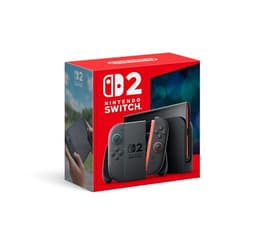
A single moulded handheld console, a little smaller than a paperback. The controls are built into the body rather than clipping off the sides, which is the visible difference from every other Switch and the source of most of its advantages and all of its limitations.
Nintendo’s own specifications for the model, which it designates HDH-001: a 5.5-inch LCD screen at “1280x720 resolution”, approximately 3.6 inches high by 8.2 inches long by .55 inches deep, weighing approximately .61 lbs, with 32 GB of internal storage expandable by microSD card. Battery life is given as “Approx. 3.0 to 7.0 hours” — Nintendo adds that this depends on the game, and gives roughly four hours for The Legend of Zelda: Breath of the Wild as its own worked example.
It plays the original Nintendo Switch game library, which after nine years is one of the deepest and most family-friendly catalogs in gaming. It has a “3.5mm 4-pole stereo (CTIA standard)” headphone jack, so an ordinary pair of wired headphones works. And its wireless specification lists NFC, which is what amiibo figures are read with — so the amiibo somebody already owns are not wasted on it.
Who it is genuinely right for
A child or teenager with their own room. The strongest case. They get a whole console rather than a share of the family one, it lives in their room, and it costs a fraction of a Switch 2. The built-in controls are also tougher than clip-on ones — there is simply less to come loose in a backpack.
A household where the television is contested. This is the quiet reason the Lite gets played more than people expect. A console that needs the living-room TV competes with everybody else in the house. One that does not, gets picked up.
A commuter, a traveller, or anybody with waiting time. Trains, flights, lunch breaks, hospital waiting rooms. It also works with no internet connection at all, which is worth knowing before you buy games for it — our guide to whether a Switch needs wi-fi covers the one Switch 2 packaging format that breaks that rule.
A second console for a house that already has one. Two people playing at once instead of taking turns, and digital games can be moved between two consoles on the same account — Nintendo’s virtual game card system lets you “freely load and eject them between your two consoles, just like physical games”. The full rules are in can you share Nintendo Switch games.
The three things it cannot do
1. It will never work on a television. Covered above, and it is worth repeating because it is the mistake. If there is any chance the person you are buying for pictures themselves playing on a TV — or if a parent pictures the family playing together on one — buy a Switch 2 instead and accept the price.
2. It does not play Nintendo Switch 2 games. Switch 2 exclusives are exactly that. Backward compatibility runs one way only: a Switch 2 plays most original Switch games, and no original Switch or Lite plays a Switch 2 game. In practice that means Mario Kart World, Donkey Kong Bananza, Kirby Air Riders and the rest of the new console’s headline shelf are off the table. Our compatibility guide runs the four checks before you buy a game for either machine.
3. Games that need detached controllers need extra hardware. The least obvious one. Because the controls are part of the body, any game built around handing somebody a separate controller — or waving one around — needs a pair of Joy-Con bought separately, and those are not cheap. Nintendo Switch Sports and the party games that assume one controller per person are the usual casualties. If multiplayer-on-the-sofa is the point of the gift, the Lite is the wrong console. Our guide to what a Joy-Con is explains what you would be buying and why it costs what it does.
What it costs once you are honest about it
We show the live price on the card above rather than quoting a number here, because console pricing moved in 2026 and a number typed into prose goes stale. What is worth knowing is the context: when Nintendo of America raised the Switch 2’s US MSRP from $449.99 to $499.99 “Beginning on September 1, 2026”, it said in the same announcement that “Pricing for the Nintendo Switch system is not changing”. The gap between the Lite and the flagship widened rather than closed.
The real budget, though, is the console plus one game. A console on its own is a genuinely disappointing thing to unwrap — no game is included — and the cheapest good Switch games cost a fraction of the hardware. Budget for both. The best Switch games to gift is the shortlist, and cozy games suit a handheld played in bed better than anything else on the site.
What you can skip: a Nintendo Switch Online membership is not required to play. Every game works without one. Buy it only if the specific thing they want is to play with friends over the internet.
So is it worth it?
Yes, with a single condition attached, and the condition is not negotiable: buy it for somebody who wants a handheld. Not somebody who wants a Nintendo console and will put up with a handheld — somebody who actively wants the small one they can take to bed, on a bus and to a friend’s house.
For that person it is close to unimpeachable: the cheapest route into the best family-game library in the industry, in a body that survives being carried around. For anybody else, the $300-odd gap between it and a Switch 2 buys a feature they will notice every single day, and skimping on it is the kind of saving that gets remembered.
If you cannot answer the handheld question with confidence, do not guess at hardware. An eShop card or a wider look at which console to buy as a gift will both serve you better than a console bought on a hunch.